

Updated on September 21, 2026 by Anthony Landolfo

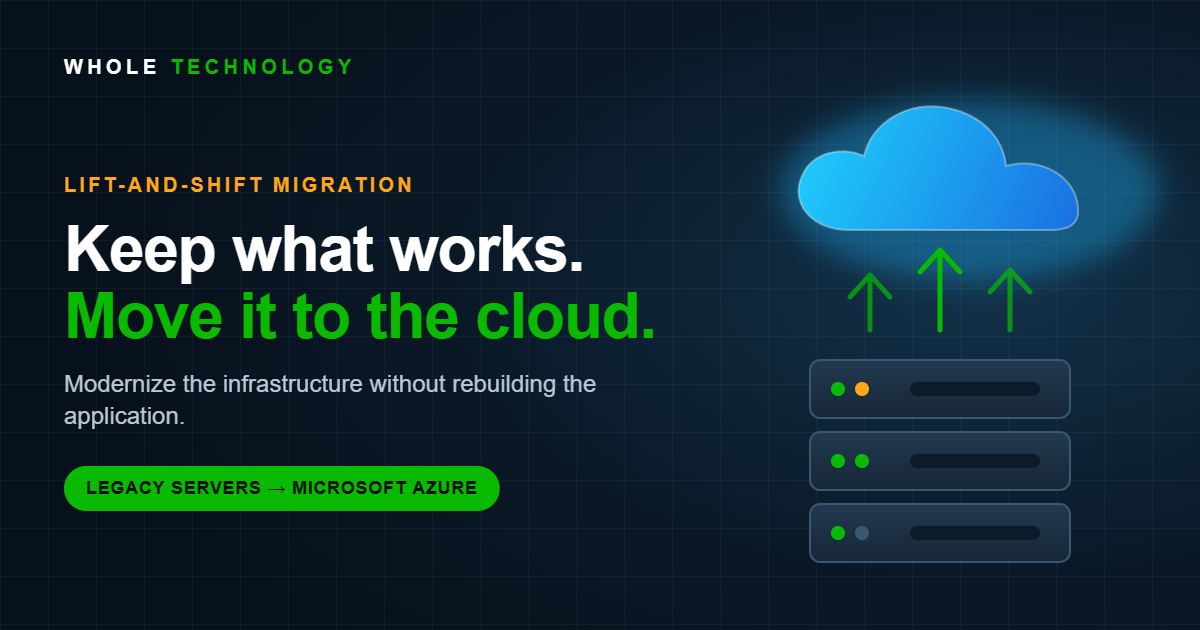
Moving to the cloud doesn’t always mean rebuilding everything from scratch.
Recently, Whole Technology helped a customer migrate a business-critical application from an aging private-cloud environment into Microsoft Azure. The application was still doing its job well, but the infrastructure underneath it had become a liability, and an expensive one to keep running.
Rather than spend significant time and money redesigning or replacing a system that already worked, we took a different approach: move the existing environment into Azure largely as-is, then modernize where it actually makes sense.
The Challenge
Like many businesses, the customer had an important application running on traditional virtual servers hosted in a private cloud. The application itself wasn’t the problem. The bigger concerns were the infrastructure surrounding it:
- Dependence on an older hosting environment
- Limited flexibility for future growth
- More complicated disaster recovery planning
- Ongoing cost and reliance on physical, private-cloud infrastructure
- The potential cost and disruption of replacing a functioning application
A complete application rebuild or replacement could have required months of planning, development, testing, retraining and potentially significant business disruption.
There was a simpler option.
Moving the Existing System to Azure
Whole Technology designed a lift-and-shift migration that allowed the customer’s existing servers and applications to move into Microsoft Azure without a major redesign. We replicated the existing servers into Azure, built the necessary networking and security infrastructure, and tested the environment thoroughly before the final migration.
Because the application architecture remained largely unchanged, the project avoided many of the risks normally associated with a major software migration. Users didn’t have to learn a new system. The business didn’t have to recreate years of application configuration. And the customer didn’t have to fund an expensive development project simply to get the application onto modern infrastructure.
Test First, Cut Over Second
One of the biggest advantages of this approach was the ability to test the migrated environment before committing to the final move. Azure allowed us to create test versions of the customer’s servers while the production environment remained fully operational. That meant we could validate:
- Server functionality
- Application compatibility
- Network connectivity
- Authentication
- Dependencies between servers
- Performance in Azure
…all before the final production cutover. Instead of treating migration day as a leap of faith, we made it a controlled infrastructure change.
Saving Time and Money by Not Overengineering
Cloud migrations sometimes become much larger projects than they need to be. There can be pressure to redesign applications, change databases, rewrite software or adopt completely new platforms simply because a workload is moving to the cloud.
Sometimes that makes sense. Sometimes it doesn’t.
In this case, the most cost-effective solution was to preserve the customer’s existing investment while modernizing the infrastructure underneath it. The customer avoided the cost of replacing a working application, and moving off the private cloud reduced the overhead of maintaining aging hosting infrastructure. With Azure, they now pay for the compute and storage they actually need, and can scale that up or down as the business changes.
Along the way, they also gained cloud-based backup and recovery options, greater infrastructure flexibility, and a platform that can continue to evolve over time. Just as importantly, the project was completed far faster than a full application replacement would have been.
Modernize at the Right Pace
A lift-and-shift migration doesn’t prevent future modernization. In fact, it can make it easier.
Once an application is running successfully in Azure, improvements can be made incrementally. Servers can be right-sized, resiliency can be improved, backup and disaster recovery can be expanded, databases can be modernized, and components can eventually be replaced with Azure-native services where there is a clear business benefit.
None of those projects have to happen all at once. The business gets onto modern infrastructure first, then makes future technology investments based on value rather than urgency.
The Bigger Lesson
Cloud migration shouldn’t be about moving to Azure simply because Azure is newer technology. It should solve a business problem.
For this customer, the goal wasn’t to reinvent a working application. It was to remove infrastructure limitations, reduce risk and cost, and create a more flexible technology foundation without spending unnecessary time and money. That is often where a well-designed cloud migration delivers the greatest value.
Keep what works. Modernize what needs to change. And use the cloud to give the business more options going forward.
Considering Moving a Legacy Application to Azure?
If your business has servers or applications running in an aging data center, private cloud or on-premises environment, replacing the software may not be your only option. Whole Technology can evaluate your existing environment and determine whether a lift-and-shift migration to Microsoft Azure could extend the life of your current systems while improving flexibility, resiliency and disaster recovery.
Sometimes the smartest modernization strategy isn’t starting over. It’s moving what already works onto a better foundation.
Contact Whole Technology to talk through your options.
